
3D Printing for Prototypes: From Digital Model to Test Part
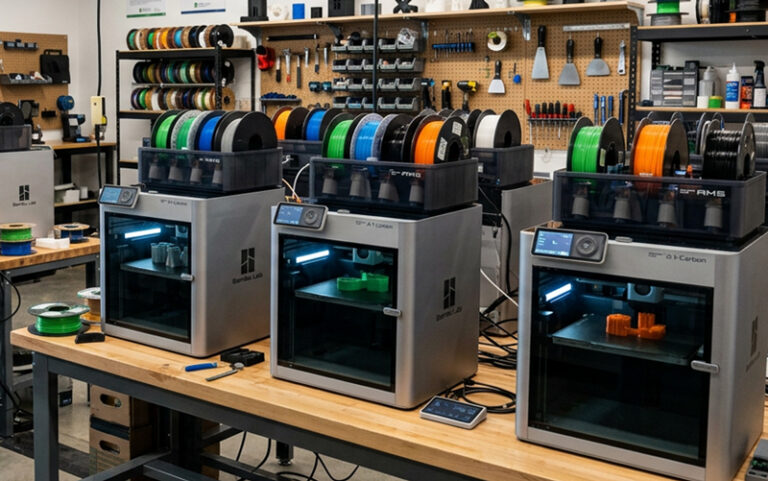
A 3D printed prototype turns a digital design into a physical part you can inspect, fit, and evaluate. It can help you find design issues before committing to a larger production run or a more expensive manufacturing process. The best prototype is designed around the question you need to answer.
Decide what the prototype needs to prove
Start by identifying what you want to learn. Are you checking the overall shape, testing whether parts fit together, evaluating ergonomics, or checking how a component behaves in use? A prototype made to confirm dimensions may not need the same material or finish as one that will be handled repeatedly.
Write down key requirements such as size, tolerances, expected loads, appearance, and the number of parts. Clear requirements help guide the design, material, and printing process.
Prepare the design for printing
A 3D printer builds a part in layers from a digital model. That makes geometry, orientation, wall thickness, and support strategy relevant to the outcome. If you already have a CAD file, review it for printability. If you only have a sketch, sample part, or concept, you may need design work before printing.
For some projects, a printed prototype is one step in a series: design, print, test, revise, and print again. NIST notes that additive manufacturing can support rapid prototyping and design iterations, especially when teams need to evaluate ideas without first creating production tooling. NIST MEP: Additive manufacturing and 3D printing
Choose a process and material for the test
The right process depends on the prototype’s purpose. FDM printing uses filament; SLA and DLP use liquid resin cured by light; SLS uses powder. Each process has different material choices and characteristics. Choose based on the question you’re testing rather than assuming one technology fits every prototype.
For a visual model, surface detail and appearance may be key. For a fit check, dimensional requirements may matter more. For a functional test, the material and design must be appropriate to the intended conditions. Ask the service provider which details they need to recommend a suitable process.
Use each version to answer a question
A prototype is most valuable when it informs a decision. After inspecting the part, record what fits, what does not, and what should change. Updating the model based on observations gives the next print a clear purpose.
If the model needs another iteration, share the changes and the goal for the next version. This makes it easier to evaluate whether the new part addresses the issue.
Start with the decision you need to make
A prototype does not have to be a finished product. It should help you learn something useful about your design. Define that learning goal, choose a process and material that support it, and use the result to guide the next step.
Have a CAD file or early concept? Explore 3D Herndon’s 3D printing service or prototype design service to discuss a quote.